Showing posts with label Epidural. Show all posts

Sunday, October 7, 2012

Compounding Pharmacies & Drug Shortage: the case of Fungal Meningitis

Epidural steroid injections have been an option in the treatment of pain due to spinal disc herniation for many years, and their safety record has been acceptable until now! As we hear in the media, contaminated steroid preparations that were purchased from a non-accredited compounding pharmacy have led to the death of 7 people and the serious illness of at least 47 individuals who were afflicted with fungal meningitis. Many more might show-up over the next days or weeks. By far, this is the worst trend of complications and bad outcomes related to the treatment of epidural steroid injections for painful spinal conditions, which in my opinion will hold back this form of therapy for many years to come, even if the root cause of this tragic development is eradicated.

Our medical history is a living proof of this: a case in point is the landmark Woolley and Roe case that occurred in Britain in 1947. Two patients who received spinal anesthesia on the same day in the same hospital who became permanently paralyzed because of contaminated ampules. Their tragic loss led to the "death" of spinal anesthesia for many years afterwards, particularly in Britain. It took a long while for the practice of spinal anesthesia to recover afterwards, particularly with modern sterilization techniques, better drugs and needles, and improved understanding of the science.

Below is an extract from an article in the Guardian regarding this story (full article here):

An outbreak of meningitis linked to contaminated steroid shots prepared by a Massachusetts pharmacy has now resulted in seven deaths, officials said Saturday as they confirmed that the illness had spread to more states. 
The total number of cases of the rare form of fungal meningitis is now 64, with Minnesota and Ohio added to the list of states affected. 
Since the outbreak was traced to products sent out by an unaccredited pharmaceutical compounding company with a history of health violations, medical clinics across the eastern USA have been making contact with patients given the injection. 
In the past 24 hours, Centers for Disease Control and Prevention (CDC) has added two people to the number of fatalities. The total number of cases has jumped by 17 from Friday's figure of 47. 
The updated figures comes amid growing concern over why clinics from as far away as Florida and Tennessee chose to buy in bulk from a pharmacy that had not applied for accreditation form a professional body and had a checkered health and safety record. 
The outbreak has been traced to the New England Compounding Center, which from premises in Framingham, Massachusetts sent out as many as 17,000 doses of contaminated steroid injections. 
Investigators from the Food and Drug Administration (FDA) who were sent to the company found a fungal contaminate in a sealed vial of the steroid methylprednisolone acetate. They also found a "foreign material" in another, opened container. Tests are being conducted to determine if the contaminants match the one that has led to recent cases of meningitis....

Tuesday, December 5, 2006

Epidural (Cont-2)


Question:
What are the contraindications of epidural anaesthesia?

Answer:
1) Patient refusal of the procedure.
2) Inability to communicate with the patient.
3) Severe psychiatric disease.
4) Allergy to the drugs used for epidural anaesthesia.
5) Low blood pressure due to hemorrhage or shock state.
6) Anatomical deformity of the spine.
7) Acute neurological disease.
8) Infection at the insertion site of the intended epidural.
9) Systemic infection and septic state.
10) Coagulation disorders.
11) Anticoagulant therapy (blood thinners).
12) Very high blood pressure.
13) Very high blood sugar.
14) Inexperience of the medical practitioner.

Some of the above contraindications are absolute and some are relative. The final decision normally rests after careful consideration of all the factors involved, and after open consultation between the patient and the physician.

Wednesday, November 22, 2006

Epidural (Cont-1)


Question:
What are the indications for epidural anaesthesia?

Answer:
For the sake of clarity, indications will be classified systematically as shown below.

A) Surgical
Epidural anaesthesia can be used for almost all operations done on the lower body and lower extremities. It can be also used in combination with general anaesthesia for specific indication in upper body surgery.

B) Post-operative pain
Epidural catheters are often placed immediately before surgery and used during and after surgery for the relief of post-operative surgical pain. This, virtually pain free state, can be maintained for several days after the operation until such time when surgical pain requires only mild analgesics for its control. Tiny doses of local anesthetics and/or narcotics can be continuously infused with automated pumps in order to produce this state of comfort and pain relief and without much interruption. Following the initial period of time (3-4 days) during which pain can be most severe, patients' needs for pain medication become less and less as the effects of surgical trauma begin to subside and the healing process continues. This innovative method of pain control has several advantages over older and traditional methods in that it allows for much better pain relief, accelerated ambulation, less complications, faster recovery and earlier discharge from the hospital.

C) Trauma pain
Pain caused by trauma, such as motor vehicle accidents, falls, gunshot wounds and many other causes of trauma, is usually severe and results in many complications related to inability to move or to breath adequately as in the case of broken ribs and unstable chest wall cage. If untreated, it can result in severe disabilities and complications. Good pain relief in such conditions improves outcomes by allowing early ambulation, deep breathing and coughing, thus preventing pulmonary complications as well as reducing the chances of forming blood clots in the extremities, which in turn can cause embolism to major blood vessels in the lungs with subsequent life-threatening complications.

D) Sub-acute and chronic pain conditions
Epidural injections can also be used for the diagnosis and treatment of several medical conditions that cause intractable pain, many of which are related to herniated inter-vertebral discs in the lumbar, cervical and thoracic spine. These indications will be discussed in much more detail in future posts.

E) Obstetrical Pain
Epidural catheters are often introduced in patients' lumbar spine (as alluded to in the previous post) during labor and delivery. Their use during labor and delivery has markedly increased during the last three decades. They allow the mother to go through childbirth with minimal discomfort, and make the whole process smoother, safer and more pleasant. Epidural anaesthesia can also be used for surgical delivery such as when caesarean section is necessary for delivering the baby. More will be written on this in future posts.


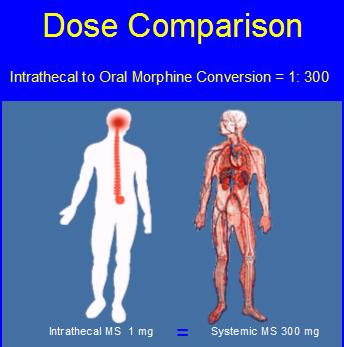
(Intrathecal means inside the spinal fluid)

F) Cancer related pain

Epidural catheters can be implanted and tunneled under the skin for long term use in the treatment of intractable, severe cancer pain. These catheters can be left in place for months and even years if necessary. They facilitate the ability to continuously infuse small amounts of pain relieving medications, such as morphine, directly into the spine, thus allowing the drug to be infused as close as possible to the central nervous system. Normally when narcotics are administered orally or by injection (intramuscular, under the skin or intravenous), they will have to cross a barrier between the blood and the brain in order to reach their target receptors in the central nervous system. By injecting these drugs directly into the spinal canal, close to the nerves and the spinal fluid, much smaller doses are required in order to accomplish the degree of pain relief that is possible with much higher doses of the drug when given systemically. The quality of pain relief is also far more superior when the drugs are delivered closer to the sites of their action. In other words, this method of administration allows us to get to the receptors in the central nervous system "by the back door." There will be more details on this particular subject in future posts.

To be Continued....

Saturday, November 18, 2006

Epidural

Question:
What is an epidural?

Answer:
An epidural is a procedure done to either provide a painless state in order to perform surgery and to have childbirth without significant pain, or is used for the diagnosis & treatment of certain chronic pain conditions.

Anatomy: there is a potential space (epi- or extra-dural) located outside the dura which is a thick membrane surrounding the spinal cord and its terminal nerve structures that are called cauda equina. The spinal cord and all these nerve structures are bathed in a watery fluid medium called cerebrospinal fluid which provides the central nervous system with protection, pressure balance, suspension and nutrition. The spinal fluid is contained in between an internal membrane called pia mater and two external coverings (membranes), the first of which is called arachnoid mater and the second and outermost layer is called dura mater.

Just outside the dura mater there is a narrow space containing veins, fat, lymphatics, and through which the nerves travel on their way exiting the spinal canal towards their target sites in the body. This narrow space is termed Epidural Space, and is surrounded on the outside with strong ligaments, periosteum (a strong layer of tissue on the surface of bone) and bony structures that form the spine.

When a person receives an "epidural" it implies the placement of a needle into that space (epidural space), and through that needle a catheter is introduced into the epidural space, then the needle is removed and the catheter is secured in place so that medications can be delivered over extended periods of time. For other specific indications, the medications can be injected directly through the needle as a "one shot" technique, and the needle is then removed.


To be continued....